TripUp
Overview
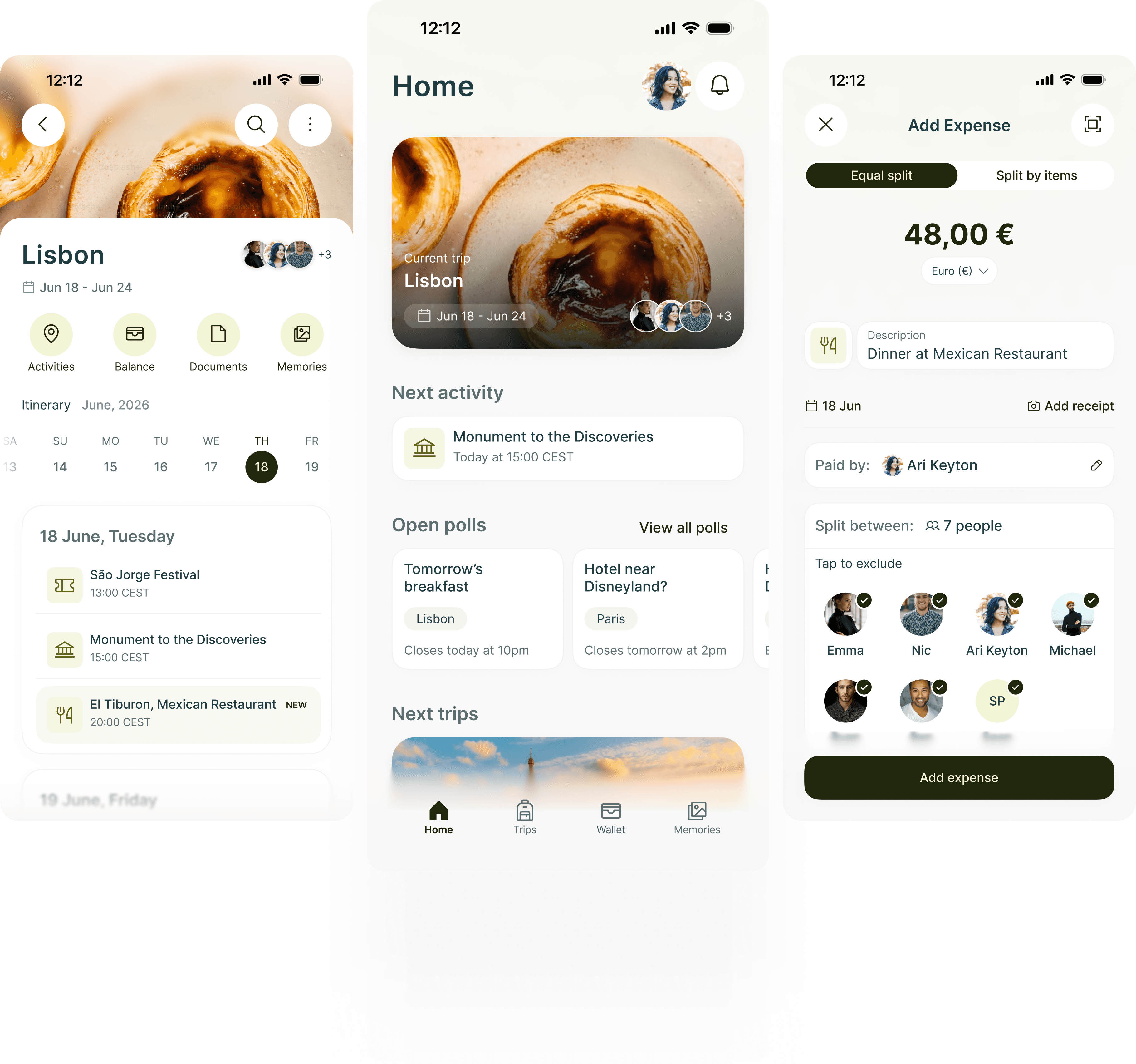
TripUp is a mobile app designed to make planning trips with friends easier. From deciding where to go and what to do to managing shared expenses, the experience brings every part of group travel into one place. User research revealed how quickly complex flows and scattered conversations could create friction, pushing people back to messaging apps and manual calculations.
User research
TripUp is a mobile app designed to help groups organize trips together.
The original concept was to reduce friction during shared decision process, simplify expense tracking and smooth the entire travel experience.
While early adopters appreciated the concept, research revealed recurring friction points:
Group decisions happened spontaneously.
Users abandoned complex flows and moved conversations to WhatsApp.
Expense management became frustrating at the end of trips.
Participants wanted to contribute without feeling overwhelmed.
The redesign focused on creating a faster, more collaborative experience for planning, voting and settling expenses.
Main insights
Key design decisions
Replacing chat chaos with lightweight polls
Problem
Group decisions often became fragmented across different channels.
Solution
A lightweight polling system allows users to:
Create polls directly within the trip
Suggest options quickly
Vote in real time
Automatically update the itinerary
This creates a reduced coordination effort and created a shared source of truth.


Making expense splitting flexible
Problem
Not every expense should be shared equally. In the scenario, some participants joined dinner but not wine.
Solution
Users can:
Add expenses quickly
Exclude participants when necessary
Update balances automatically
Reducing settlement complexity
Problem
Settling expenses between multiple people creates unnecessary transfers.
Solution
TripUp consolidates debts automatically and calculates the minimum number of payments required.

The whole process
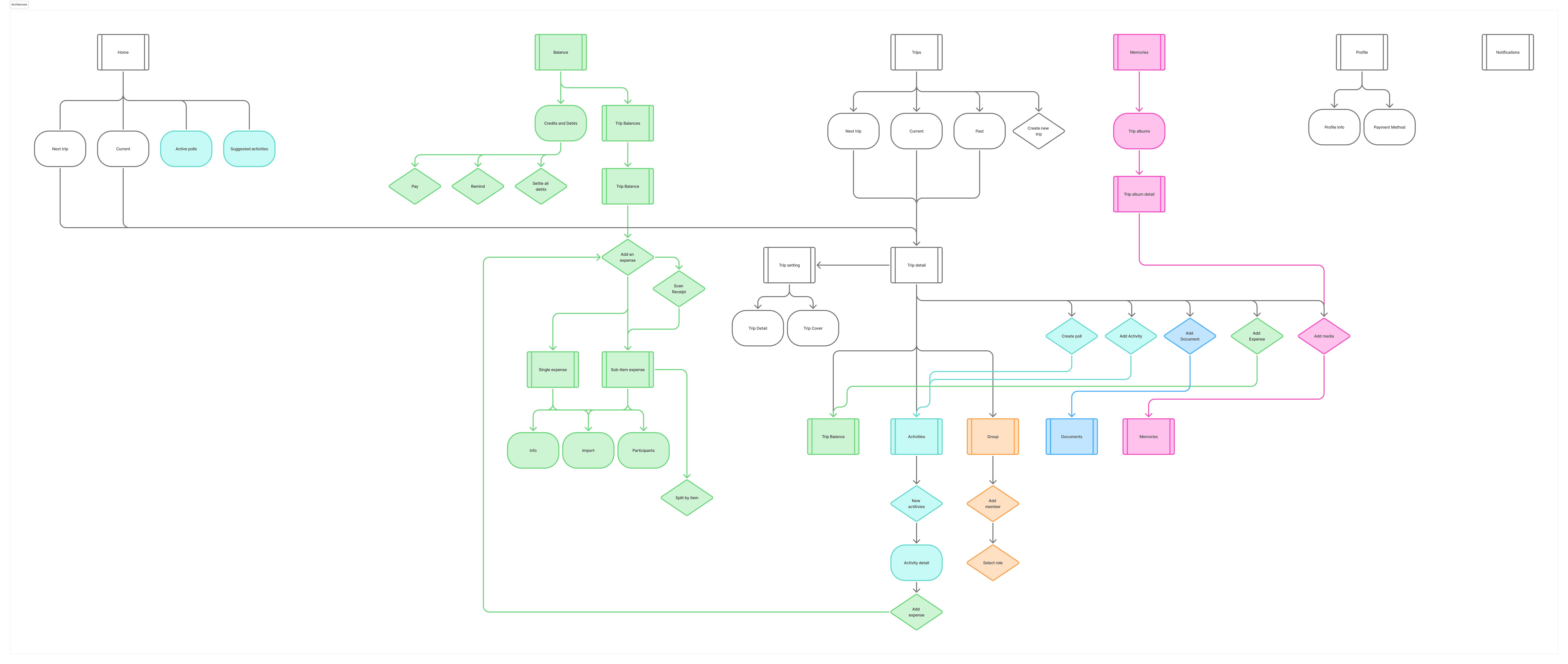
Structuring a complex travel experience
Trip planning involves several interconnected activities:
Coordinating people
Making decisions
Managing itineraries
Tracking expenses
Settling balances
One of the main challenges was creating an information architecture that kept these activities connected without overwhelming users.
User Flows and Wireframes
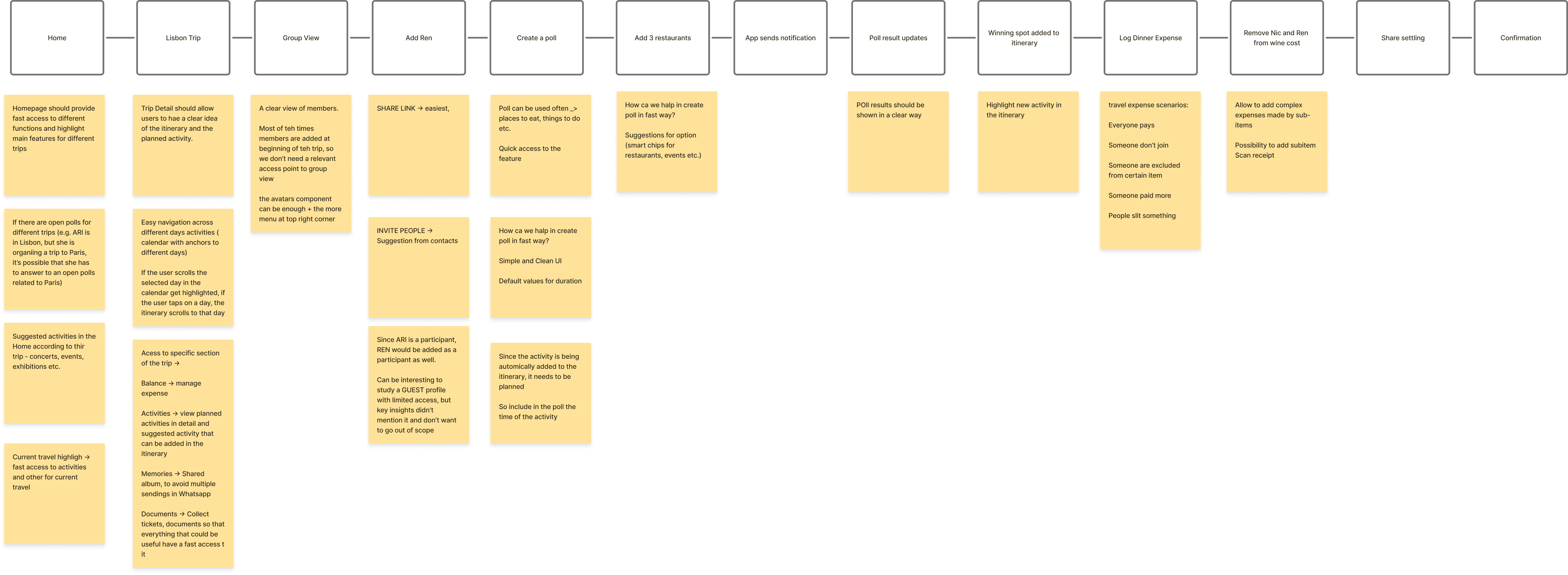
Based on the research findings, I mapped the complete end-to-end experience to identify moments where users were most likely to abandon the app and move conversations elsewhere.
Particular attention was given to three critical flows:
Creating and voting on a poll
Users needed to suggest options and reach decisions quickly while on the go.
Logging shared expenses
The process had to support both simple and more nuanced scenarios, such as excluding specific participants from selected costs.
Settling balances
The final settlement flow focused on minimizing effort by consolidating debts and reducing unnecessary transactions.
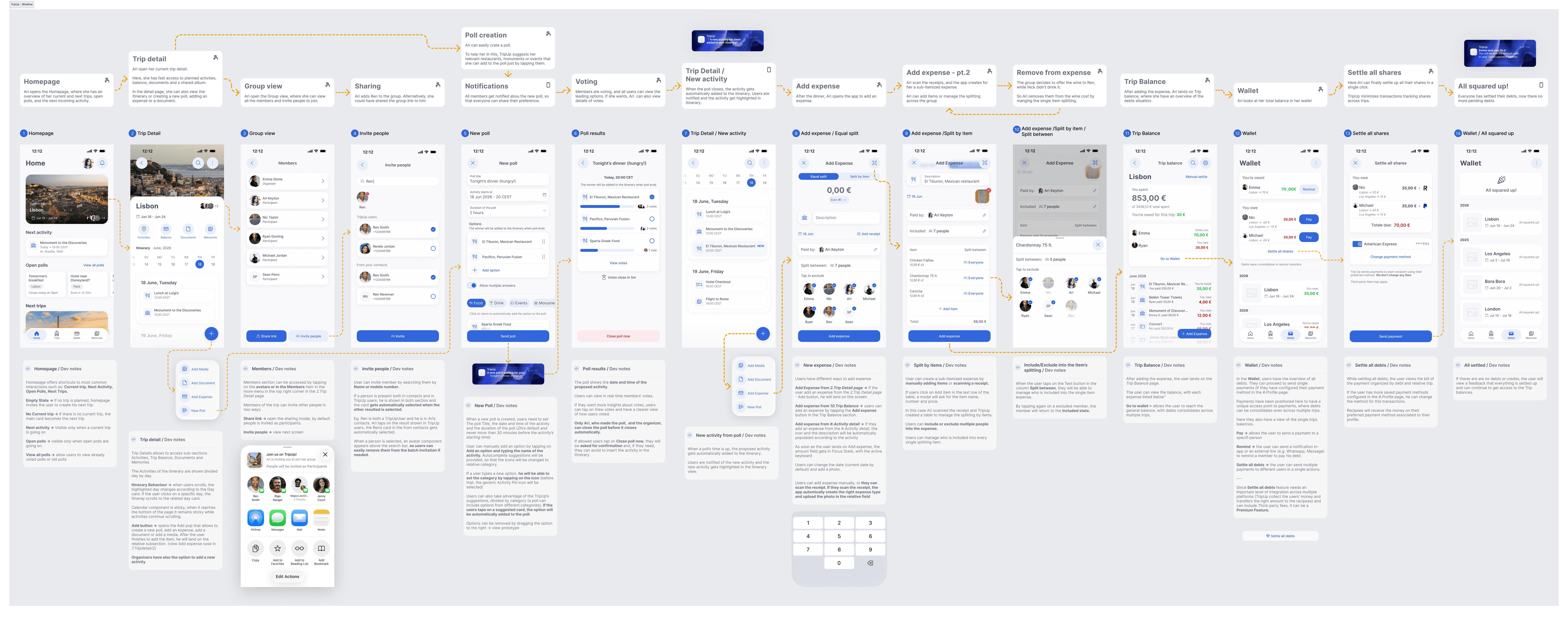
To validate navigation and task completion, I created a detailed wireflow covering the entire scenario from trip planning to final settlement.
User Testing
Evaluating clarity and efficiency
After defining the architecture and workflows, I conducted usability testing with users representing both primary personas:
Organizers
Participants
Participants were asked to complete realistic travel-related tasks based on the project scenario.
Key tasks
Create a poll and vote on a restaurant
Add a shared expense
Exclude selected users from a cost
Understand their balance
Complete debt settlement
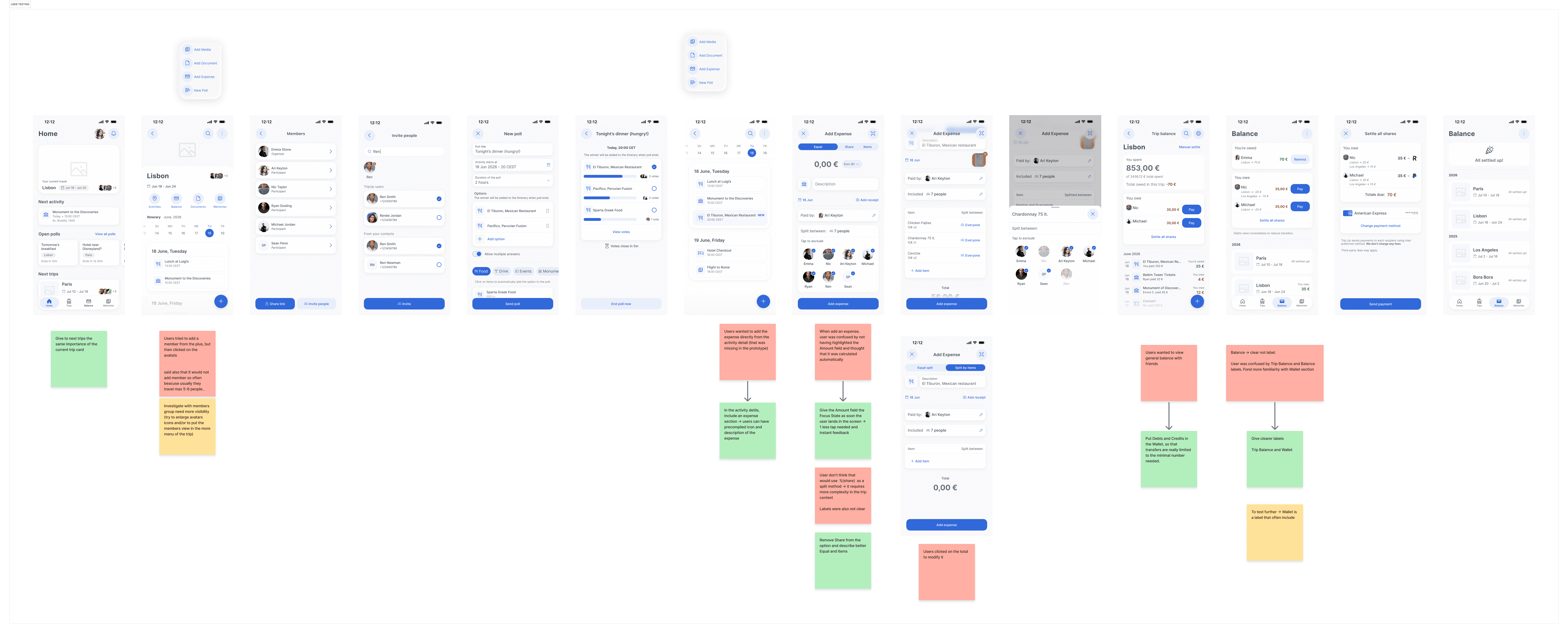
User Testing key findings
Poll creation was intuitive
Users quickly understood how to create options and participate in decisions.
Expense splitting required additional clarity
Some participants initially expected expenses to be split equally by default. To address this, I improved visibility around participant selection and exclusion.
Balance information was highly valued
Users consistently appreciated having a clear overview of who owed what and why.
Settlement generated the highest satisfaction
Participants responded positively to the debt consolidation approach, which reduced the number of required payments.
Insights from testing led to several improvements:
Simplified expense management flows
Clearer balance summaries
Stronger hierarchy between trip balances and overall balances
Reduced cognitive load during settlement
These refinements helped create a faster and more intuitive experience aligned with the project's goal of minimizing friction.